
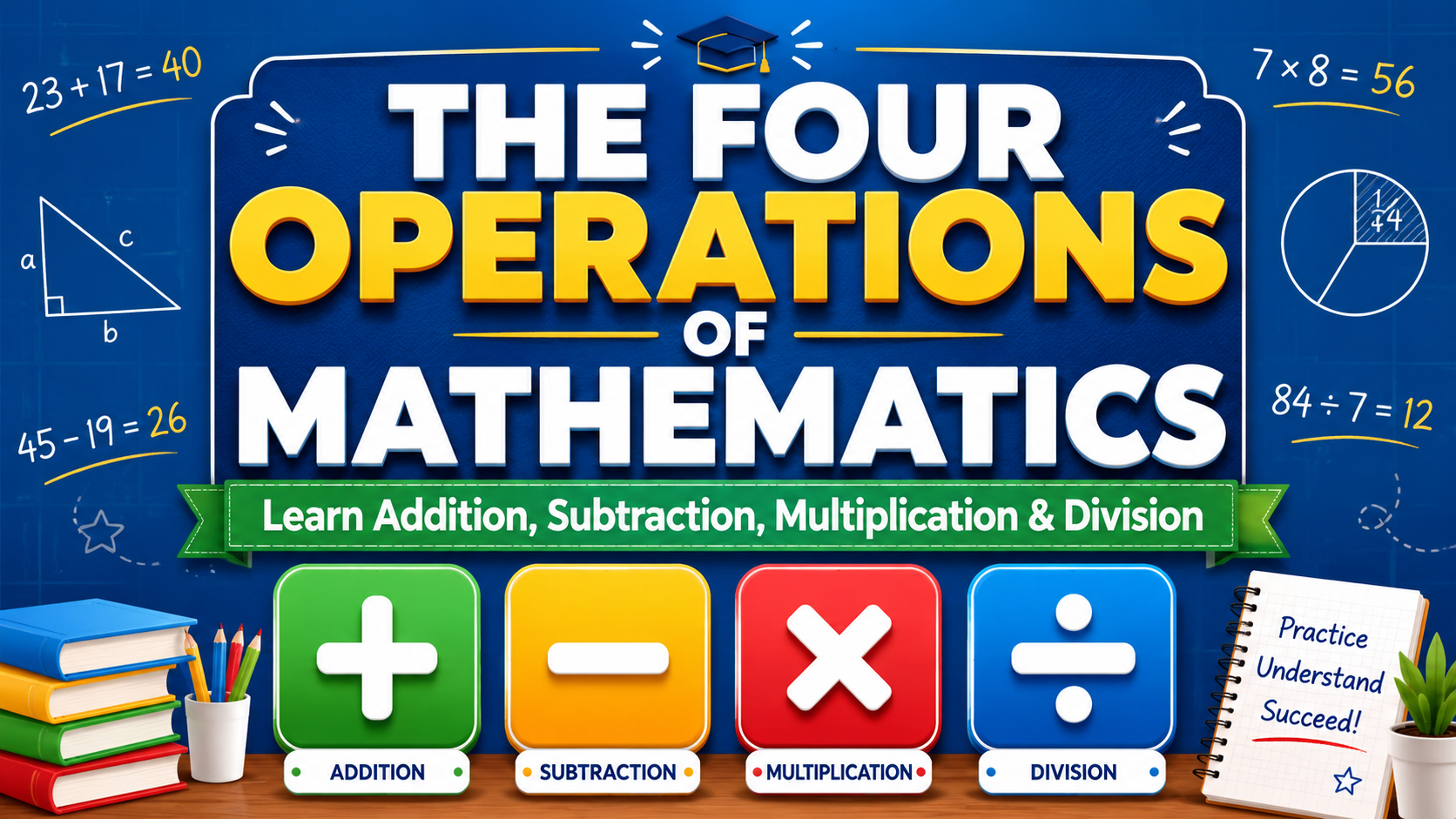
Understanding the Four Basic Operations
Mathematics is built on fundamental principles, and at the core of these principles are the four basic operations: addition, subtraction, multiplication, and division. These operations form the foundation of arithmetic and are essential for solving problems in everyday life and advanced fields like algebra, calculus, and beyond. Mastering these operations unlocks the ability to tackle complex calculations and deepen your mathematical understanding. Let’s dive into each operation to explore their definitions, examples, and significance in mathematics.
Addition
Definition
Addition is the process of combining two or more numbers to find their total. It is represented by the plus sign (+) and the result is called the sum. For instance, combining 3 apples and 2 oranges gives a total of 5 fruits.
Symbol and Notation
- The addition symbol is:
+. - Example notation:
3 + 2 = 5.
Examples
7 + 4 = 1120 + (-5) = 15(combining positive and negative numbers).
Real-World Applications
Addition is used in scenarios like calculating total expenses, tallying scores in games, or adding ingredients in a recipe. It helps us understand how quantities grow when combined.
Subtraction
Definition
Subtraction is the operation of finding the difference between two numbers. Represented by the minus sign (-), it determines how much one quantity exceeds another. For example, if you have 8 cookies and eat 3, subtraction tells you how many remain.
Symbol and Notation
- The subtraction symbol is:
-. - Example notation:
8 - 3 = 5.
Examples
15 - 7 = 810 - (-4) = 14(subtracting a negative number increases the value).
Real-World Applications
Subtraction is vital for measuring changes, calculating discounts, or determining time remaining. It represents the idea of “taking away” or “finding a deficit.”
Multiplication
Definition
Multiplication is a shortcut for repeated addition. It combines equal groups to find their total. For example, multiplying 3 groups of 4 apples gives 12 apples in total. The key terms are multiplicand (the number being multiplied) and multiplier (the number of groups).
Symbol and Notation
- Multiplication symbols include:
×,·, or*. - Example notation:
3 × 4 = 12.
Examples
6 × 7 = 42(-2) × 5 = -10(sign rules apply).
Real-World Applications
Multiplication simplifies tasks like calculating area (length × width), scaling recipes, or determining total costs. It enables efficient computation without repetitive addition.
Division
Definition
Division is the inverse of multiplication, breaking a number into equal parts. It answers questions like, “How many groups of 3 fit into 12?” Division uses the symbols ÷ or / and produces a quotient. It’s essential for fair sharing and analyzing ratios.
Symbol and Notation
- The division symbol is:
÷or/. - Example notation:
12 ÷ 3 = 4or12 / 3 = 4.
Examples
20 ÷ 4 = 515 ÷ (-3) = -5(sign rules affect the quotient).
Real-World Applications
Division organizes resources, calculates averages, splits bills, or solves sharing problems. It ensures equal distribution among groups, making it indispensable in daily life and science.


Reviews
There are no reviews yet.